Sinus Tach Part 1

Abnormal vital signs are always something to keep an eye on. Always important to explain it in documentation, but keep an eye on the trend throughout your shift as it’s one piece of information that might tip you off that something else may going on. Try to resolve the vital signs prior to discharge, looks better from a chart buffing standpoint, but also an indication that you have corrected the original problem. And if you can’t, again explain it, or just don’t discharge the patient. You will never be 100% in this job, and your initial impression could be flat out wrong, so putting in little safeguards to protect yourself, from well yourself, can help you not miss things.

Quick case…..47 y/o M, history of 75% TBSA burns, active c-diff, PNA presents to the ED for low Hgb. Had Hgb of 7 at NH, 6.4 when checked here. Was just discharged recently from our ER (by myself, VSS at d/c) with new blisters on L scalp, Hgb was 7.3 at that time, 7-7.8 on prior visits. Wbc count: 11.8. Chronic indwelling foley. Urine dip: blood/wbcs/bacteria, neg leuk esterase/nitrite, already on levaquin for known PNA as well. Sinus tach to 120s. Received transfusion x2 units and initial plan was d/c back to nursing home per initial resident. Checked out to 2nd resident (myself) HR remained tachy to 120. Medicine consulted for admission. He was Afebrile. Blood cultures/urine cultures/ sputum cultured ordered as he did have an elevated WBC. Broad spectrum abx ordered. Rectal temp ordered x2, which were both normal. Medicine consulted for low hgb, sinus tach, and they cancelled cultures and abx, felt it was due to anemia although it did not improve with 2 unit transfusion (they are not always right). Planned for anemia work up and obs.

The patient admitted to the hospital and transfused. Hgb trended down again and patient required transfusion again on 9/26. Neg hemoccult/GI bleeding. Anemia work up not completed, but appeared to likely be of chronic disease vs iron deficiency. Patient became febrile on 9/23, BP dropped (that’s 3 days later…..) Started on broad spectrum abx, pan cultured. Urine grew acinetobacter. Blood cultures neg/c-diff negative. Hypotension was not responsive to fluids. Palliative consulted, patient and family elected to be comfort care. Made DNR. Comfort measures in place, was to be discharged to hospice. Patient subsequently expired prior to discharge on 10/4, etiology believed to be sepsis.

This patient had obviously a lot going on. Sinus tach could’ve been from anemia, pain, sepsis, stress, anxiety, etc. The initial thought it was due to anemia. but if this was true, it should come down with fluids and/or blood? Or at least partially respond? But it didn’t budge. He’s obviously had a long in-house history with the history of the burns so he was set up for a resistant bug, odd presentation. And honestly when we start seeing PNA + UTI we should start leaning towards sepsis from 1 agent with seeding, rather than a PNA and a UTI as two different infections going on. But in the end when he was checked out to me and the HR hadn’t budged, that was the tip off that something else was going on.

To expand on this as you can see things weren’t handled as they should’ve been initially. I see some people use the medicine service as a consultant. Which I thoroughly don’t believe in. They practice essentially the same thing as us, except less broad, more in depth, and a hell of a lot more boring (yes offense). When we talk to NES or neurology, or OB, or any of the other sub-specialties we are generally looking for guidance and information about a practice that is beyond our skills, beyond just basic medicine. And they have texts/papers/experience/OR time that allows them to function as a consultant and specialist in their area (especially the surgical services!).

But the medicine service is not all that different from what we do. When we call them, it shouldn’t be, “come see if this guy is ok for discharge.” We know which ones are and aren’t. And if you don’t, read more, use 5-minute EM consult, follow up on the patients you admit, so you can get a better understanding of what happens beyond the ED. You might not know the entire algorithm for hyponatremia and what work up they exactly do, but you should know when to admit one and how to emergently treat it. Or when to transition from insulin gtt to metformin, but you know when the glucose is too high to dispo home. Etc etc……. In their defense, sometimes we call them with patients that can theoretically be managed at home to begin with, but don’t fool yourself into thinking they know exactly what can go home and what can stay, and that they are the almighty, all-knowing doctor (case in point above.) They are residents too, and they don’t have an attending looking into them real time like you do (they have uptodate, which I can only assume why it takes 6 hours to admit asthma or whatever.)

Anyways to get back to my points.
1.Keep a close and scrutinizing eye on those VS.
2.And don’t let medicine pretend to be smarter than you.

Case #2

Case #2:

30 yo F h/o morbid obesity and DM2 not well controlled on insulin and metformin presents after high speed MVA vs pole. 5 month old baby in back carseat sent the the Ped’s ED, unharmed. EMS called, prolonged extrication about 30 min, vitals en route stable, BP 120/76 and HR 96 just PTA (hmm?). No IVs established, axox3, talking, calm and cooperative.

On exam, breath sounds normal, seat belt sign obvious on lower abdomen with mild LUQ abdominal tenderness on exam, main c/o left thigh pain. Appears twisted but unsure if broken. Patient is morbidly obese, probably 350-400 lbs, which causes some problems next: placed on the monitor and HR 130, check pulses and does have pulses in distal extremities though weak, BP unable to get multiple times, then manual BP unable to obtain. Ask nurse why no BP, states “cuff not big enough to work properly,” also trying on leg.

IV placed in right AC no problem, placed NS on pressure bag. HR during xrays comes down from 130–>115.

CXR done nothing obvious, PXR done, again nothing obvious and left femur show proximal 3rd shaft fx, traction splint placed by intern, FAST scan neg in cardiac window, but very positive in pelvic window as well and slightly positive in RUQ and LUQ. Level 1 called after FAST and finally a BP obtained 80/40 as trauma walks in the door!!! Patient no longer with palpable peripheral pulses, good central pulses, a&ox3.

Ever feel like an idiot…just watched this lady with HR 130 and BP 80/40 for 18 minutes prior to level 1 trauma call!

Blood, central line, another peripheral IV. Trauma dawdled a little in ED more than should have, repeated the very positive FAST scan, though we did resuscitate her with blood and fluids, central line, trauma attempted a-line (apparently they didn’t trust the very low BP either) and finally went to CT scanner (another 25 min) and thought to have SMV avulsion (yikes) prior to taking her to the OR.

Diagnosis: avulsion of superior mesenteric artery (even worse). left femur fracture.

Patient spent more than one month in the SICU, never extubated, multiple loops of bowel resected for necrosis and never closed her abdomen, family decided to withdraw care after she continued to go downhill and quality of life would have been an issue.

Let me point out the obvious, I should have called a level 1 earlier. 10 min earlier when  had HR in 130s and unable to obtain BP x 2 would have been enough. Unsure if her outcome would have been different, but sure makes me wonder.

Often times it is hard to get a BP on a morbidly obese person, esp when have peripheral pulses and axox3, but it is much better to be safe than sorry, call the level 1 when in doubt. Better for the patient’s sake to feel like an idiot earlier than to feel like an idiot later in the game.

The other thing is, we had her packaged for the OR when trauma arrived, peripheral IV and blood obtained, 1L fluids, HR 110, CXR, PXR and femur, traction splint to femur, FAST done and very positive. Should have gone straight to the OR as soon as trauma arrived. Trauma fellow wanted CT scan and further resuscitation (why try an a-line?) which took time.

Feedback and comments appreciated.

Couple of recent cases…

One of the most interesting posts recently was Zach’s post about what he could have done differently. Thought I would continue this trend and post a couple of cases that could have gone better and leave some things up for discussion. Case one here and two next post.

Case #1: 90 yo F h/o HTN and arthritis, restrained passenger of moderate speed MVA, driver was unharmed but car was going too fast and struck the back of a semi-truck. Extrication about 10 minutes. Patient c/o right leg pain and right forearm pain, skin tear to right arm and obvious Colles fracture and femur fracture likely as well on initial exam. No chest or abdominal pain. Kept in R9 for the potential femur fracture and age. Vital signs all been stable, patient a&ox3, talkative and despite mild pain appears in good spirits.

On initial exam, HR 96 and regular, 125/70, RR and temp normal. Pain controlled as long as not moving. Good breath sounds, minimal chest tenderness on palpation of sternum, abdomen and pelvis unremarkable. Placed in traction splint in R9 for significant pain and shortening of right leg. CXR normal, PXR normal, and R femur with proximal femur fx minimally displaced. FAST neg. Give tdap and bag of LR. Further eval shows pain in right leg from femur/knee/tib/ankle and also left femur/knee/tib. As mentioned obvious fx right Colles, with pain in right elbow/forearm/wrist/hand and  also pain left forearm and wrist. That makes for man scan + a whole ton of xrays in all extremities.

Spoke with ortho on the phone in R9 due to known femur fracture. Vitals on R9 exit unchanged. To the CT scanner. Nurse calls from xray after CT done and asks for small amount pain meds as patient now c/o more pain, especially in right leg and arm. Dilaudid 0.5mg ordered. Patient comes into main ER literally 90 minutes after initial presentation due to so many xrays! (This is my fault). Labs unremarkable, Hgb 11. I see the CT scans but nothing obvious to me, no head bleed, no c-spine fx, no PTX, no obvious free fluid in belly. See patient as she as she comes back bc ask for more pain meds. HR now 120s, irregular?, BP 95/65. Ask nurse how long this has been going on, states “oh, just the last 30 min or so.” Ortho at bedside as well, wants to do sedation.

EKG done, show afib rate 120s (no h/o afib). BP cont to be 90/60s. Giving 2nd L LR, nurse start 2nd IV and get L NS going. Patient still talking and states she feels ok other than the pain in her leg. Call to Trauma (should have called earlier in 90 yo with known femur fx), but by now its been more than 100 min total time in ER. Trauma arrives pretty quickly, patient now been here 2 hrs. Agree with fluid boluses, talk about patient condition with fellow and wedge and all agree think likely due to trauma in afib and that why BP sucks.

Tell ortho that too high risk patient and unstable to do sedation. Does hematoma block right Colles fracture with reduction as well and leaves the femur in traction. Admitted to SICU after just over 2 hours in ER. CT head and c-spine only scans back and are neg at admission. About 30 min later rest of man scan comes back. Small nondisplaced sternal fx and very small hematoma (but possibly active bleeding) to right retroperitoneal area. Again speak to trauma about this. Asked about the retroperitoneal bleed and fellow states it very small and should wall off without intervention based on place. Possibly afib due to contusion? Cards was consulted by Trauma who saw patient and said to control pain, resuscitation and other trauma factors (unhelpful but true, not much for them to do).

Brings up a question I had, in setting of trauma, what medicines should be given for afib with RVR? Cardiac contusion? Or just let it ride? Trauma asked the nurse to give metoprolol but this was never given mainly due to nursing concerns about BP.

Ok, long story short, HR cont to be 120-130s, afib, BP 90/60s, after being ICU hold for about 2 hours patient had decreasing mentation. Trauma placed central line and a-line and ABG showed pH 6.8! Istat Hgb 8.0. Blood given, minimal response.

Patient intubated by trauma, arrested during intubation, one round CPR and came back, went to SICU same vitals, called in IR and intervention showed minimal bleeding, thought to likely be venous, but did have several coils placed. More blood and then pressors through the night. Arrested 2 more times throughout the next 6 hrs, family still wanted all interventions. Finally about 12 total hrs after ER presentation, arrested for about 20 min and TOD called.

Couple of main points from this case that I learned and hopefully helpful for you all:

1. As Coleman says, old people go down hill quickly, be on your guard no matter how good they may look on presentation.

2. Be careful of ordering too many xrays, me not seeing the patient for over an hour while in xray is unacceptable, I should have known the change in her vitals either by seeing it directly or have nursing tell me.

3. I knew this was a trauma admit as soon as she hit the door being 90 yo and femur fx, but I didn’t call them for a long time, why? Bc I didn’t have much to tell them (couple xrays, stable VS, man scan taking 3 hrs to get read). But just be sure to get them involved early.

4. We don’t typically repeat labs or get istat too often, but for someone like this who takes a turn for the worse, would have been worth it to get hgb after her vitals became unstable.

5. Her mentation decreased after admission, but I could have been more aggressive with central line and resuscitation (blood), she got 4L crystal but needed products.

6. This one was pretty clear cut that should not do sedation, but don’t be afraid to tell ortho ‘no’ if you’re worried about their safety.

7. I’m sure there is more, would appreciate your thoughts and comments…

Fever from Africa…..

Just stop right there. It’s not ebola.

It’s malaria (unless the patient is uncontrollably vomiting blood or has participated in the cultural burial practices of West Africans within the past couple of weeks).

Seeing as I’ve had two patient’s with malaria, I thought it’d be nice to share some of the great resources I’ve come across (had med students look up), while treating these guys.

1. First off is the CDC malaria map: http://cdc-malaria.ncsa.uiuc.edu

You can see where malaria is endemic, and you click on different countries to see speciation and resistance.

2. Next is the CDC treatment recommendations: http://www.cdc.gov/malaria/resources/pdf/treatmenttable.pdf

Get a good history and know where the patient has travelled. This has doses for adults and children, so it can be useful at Kosair or out in the community too.

3. Clinical Pearls

  • Transmitted by the Anopheles Mosquito
  • Classically will have fevers/symptoms spiking every 24/48 hours
  • Severe Malaria (ICU admission): AMS, severe anemia, DIC, parasitemia >5%, metabolic acidosis, AKI/liver injury, hypoglycemia
  • Probably best to admit/observe all patients until you have a viral load and get treatment started at the hospital. Some of the antimalarials can be hard to come by and these patient’s can get sick.

The competition

It turns out that the Mayo EM program has a little room9er of their own… except it’s public… and updated frequently… and has a fellow generating content for it. Truthfully, it’s a great site. Quite a few reviews on topics that don’t pop up on the other FOAMed sites (the killer rashes, retroperitoneal hematoma, tumor lysis syndrome). Worth a look if you’re stuck at Jewish South with a broken CT scanner).

Mayo EM.


Stroke or seizure?

A middle age male with history of HTN, smoking, and seizures presenting with “mini seizures” since last night. History of a TBI and subsequent seizure disorder back in 1998. Takes phenytoin for it, used to be on phenobarb as well but was taken off of it 1.5 months prior. His seizures have been of the generalized, tonic/clonic variety in the past. Since last night he has had L sided numbness on his face/arm. They have been episodic, coming every 10 min, and they last 2 min. He feels some “clumsiness” in that arm during these episodes but no reported weakness. No difficulty in speech/vision/swallowing. No fevers/chills/LOC/convulsive activity noted.

Phenytoin Level: 14.7
Labwork unremarkable
CT head: negative for acute pathology

Stroke or seizure? I wasn’t sure and I had the attending meet the patient as well. Both of us felt like these were probably seizures. Now I very rarely call neurology about seizures but you can make the argument that this is status so I called them. However, they informed me that isolated sensory symptoms for a seizure is VERY rare and that you are dealing with a possible stroke until proven otherwise. That was news to me, but to his point this was the first case I’ve seen. Anyways, we got the MRI/MRA and they were negative. His EEG showed multiple R sided epileptiform discharges. Loaded him with keppra in the ER, and a repeat EEG improved the seizure activity noted symptomatically and on the EEG. So yay, no stroke!

Main reason I point this out there is to avoid the pitfall of missing a stroke, as Neurology themselves were highly suspicious. Our initial thought process ended up being right, but in order to get there, the point here is to rule out stroke first! Same thing with a Todd’s paralysis BTW. Rule out stroke before you start making that assumption!

For any of you big Pharm conspiracy theorists

I think I’ve shown this to a few of you, but this is an interesting article  Droperidol Article

Kind of amazing how some extremely dubious data can affect clinical practice for years, and take a great medicine out of our hands.

Also, do you think these QT concerns that we are now hearing about with Zofran have anything to do with the fact that its now waaaay cheaper than it used to be?   No one seemed worried when it was raking in the cash.

droperidol comment

Droperidol Black Box

droperidol or olanz

droperidol safety

droperidol – midaz

Expert central lines

Fall: it’s that time of year when the PGY-1s start holding down the MICU.

If your MICU experience is like mine, you’ll get a few texts on the overnight from the medicine PGY-3s asking for help placing central lines. I’d put in a couple subclavians in the OR as a medical student and the venerable (legendary) Jason Mann had shown me some tricks, but I was definitely nervous being the go-to person.

Found these great videos for EM docs on central line placement. Most of the videos I’d seen before were showing you how to identify landmarks and such – these are a level beyond that and offer some great information and tricks for more expert line placement. Worth watching about once a year through residency.

Here’s part 1. Just search for parts 2-5 if it’s helpful.

A Solution to Everyone’s Problems

Can’t get pain meds after KASPER exposed your nasty habit, so you turned to your old friend heroin? Or you can still get your pain meds, just haven’t learned when enough is enough? Is the fear of stopping breathing really putting a damper on your narcotic addiction? Have no fear, Evzio is here.

This is old news as it was FDA approved in April, and my friend from NY says it is already being used there, but I hadn’t heard anyone talking about it. Evzio is similar to an EpiPen, but delivers a single dose of 0.4mg of naloxone instead. Once it is turned on, it gives verbal instructions in how to use it. It is now available by prescription only.

Has anyone written a prescription for this, or do you see yourself doing so in the near future? Obs your heroin addictions, give them a prescription, and out the door? Not sure how much it costs, but I saw one report that it may cost as much as $500. Goodrx.com lists the price as $591 for one kit of 2 autoinjectors, with a coupon.

http://www.fda.gov/NewsEvents/Newsroom/PressAnnouncements/ucm391465.htm

http://www.nytimes.com/2014/04/04/health/fda-approves-portable-drug-overdose-treatment.html

Ketamine’s Kryptonite

I witnessed the third patient to have apnea as a side effect of ketamine administration. As in the other two cases ketamine was infused as a push, rather than the slow administration. This was not the resident, but typically and to be by the book, MDs should be the ones pushing ketamine. SLOWLY.

In this case our resident did well managing the sedation. Hypoventilation was diagnosed well before desaturation. Painful stimuli did not induce respirations as the ketamine is too good of an analgesic. We began to BVM ventilate, placed nasal trumpet, sat was never lower than 85%. Took about 8 minutes to get spontaneous respirations. We gave narcan as the patient had fentanyl prior to ketamine. As in one other case of ketamine apnea the narcan did not help, but should be attempted.

So learning point. NEVER SLAM ketamine into the patient. Dilute the 1cc (50mg-100mg) of ketamine in 10cc of saline if it will help the temptation to push it.

Also follow the algorithm below for PSA intervention. We will have the sedation review sheet and reference card finished soon.


Wellens’ Or Not?

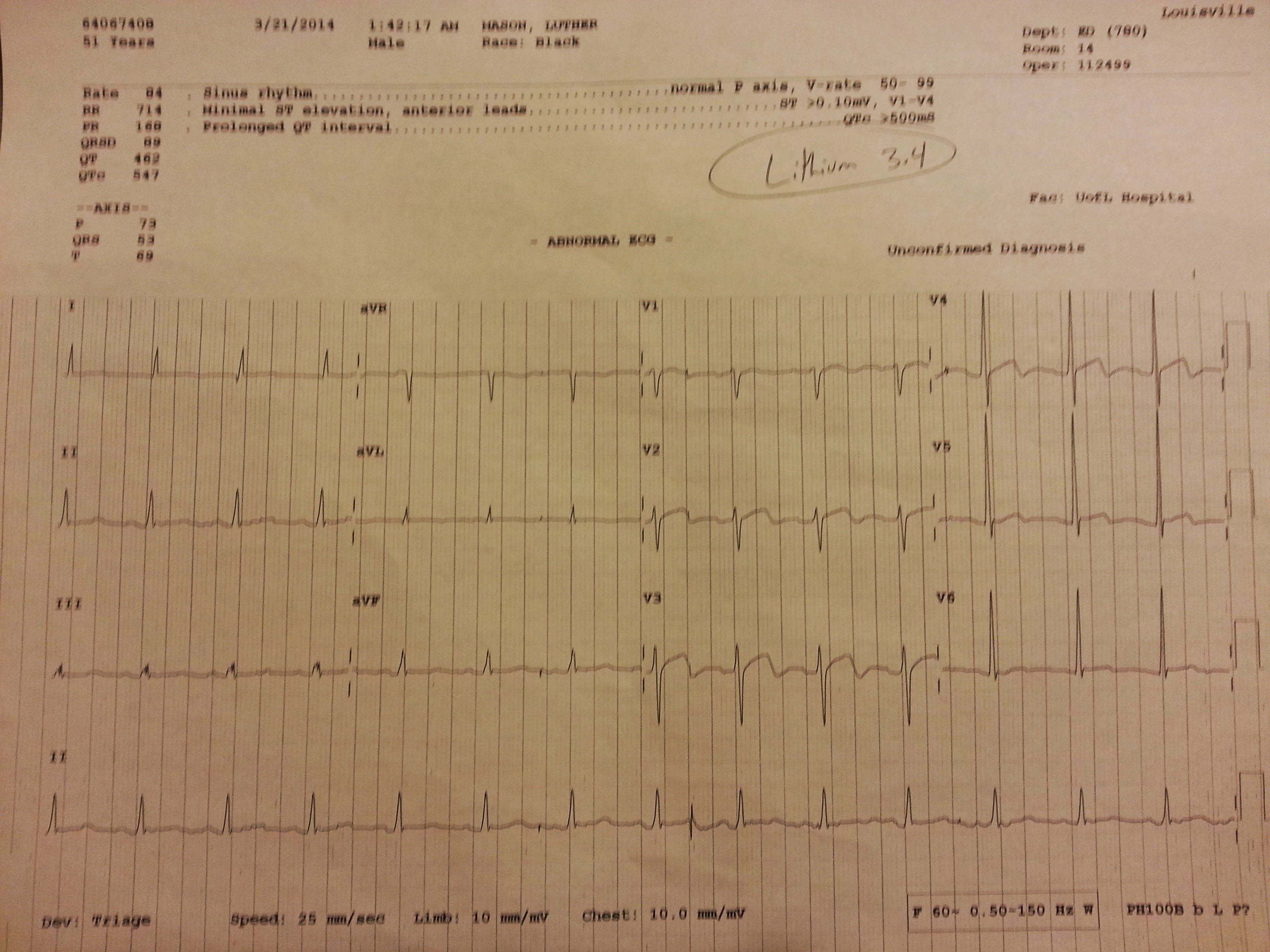
A middle aged male presented for evaluation of AMS; he had agitation, confusion, and tremors. He has a history of Bipolar disease and schizophrenia as well as HTN.  Vital signs were all stable on presentation and within normal limits.  On exam he was oriented only to name, but not place or time. Neurological exam was normal, with the exception of tremors.  Med list includes Haldol Injection, Lithium, Benztropine, Olanzapine, and Propranolol.  At this point, I was not quite sure what is going on with him, so I had a bit of a shotgun approach.  Initial EKG revealed the EKG below.

20140325_223727

It appears to be similar to Wellens’ syndrome but not consistent with my gentlemen’s symptoms.

A quick literature search revealed a case report showing lithium induced EKG changes, similar to his EKG above.  Further supporting his lithium induced changes in this scenario is no clinical findings to suggest ACS, and a negative troponin 3x.  He was ultimately admitted and treated for lithium toxicity, without any cardiac complications.

EKG changes seen in lithium toxicity:
– ST elevations (1 other single case report)
– QT prolongation
– non-specific ST segment changes/T-wave abnormalities

The Trauma-Stroke Eval

Middle age male brought into Room 9 s/p crush injury. The patient was reportedly crushed against a box truck and a wall for a short period, but no prolonged extrication.

He complains of LUQ chest pain, pleuritic in nature, and denies abdominal pain. He was ambulatory after the event. PMH only significant for HTN, otherwise no PSH, no allergies, and takes lisinopril and hydrochlorothiazide.

He is AOx3, moving all extremities, well appearing in Room 9, and acting appropriate. He goes for man scan as he did strike his head and although can give me all the details of the accident he reports LOC.

Upon return from the CT scanner his VS are stable, and is placed in a regular ED bed.  Image review revealed multiple rib fractures, and suspicious appearing spleen.  Radiologist confirms grade 1 spleen laceration, but no active extravasation, as well as bilateral rib fractures.

While evaluating another Room 9 patient, the nurse came to update me that the patient was now unresponsive and foaming at the mouth.  I told her to give Narcan, thinking it could be iatrogenic analgesia toxicity, and I would be right there.

I arrive in the room, and he does NOT look right. He is foaming at the mouth, the narcan certainly changed his pupil size when she gave it, but did nothing to his mental status. Sternal rub, nipple pinch, and ammonia capsule all failed to appropriately arouse him.  The trauma resident is now at the bedside as well and just as perplexed as this isn’t what I described on the phone. I call radiology ask them to re-check his CT head but they said no, they see nothing. I again re evaluate him and now he will move only his L side, and follow commands on the L side of his body.

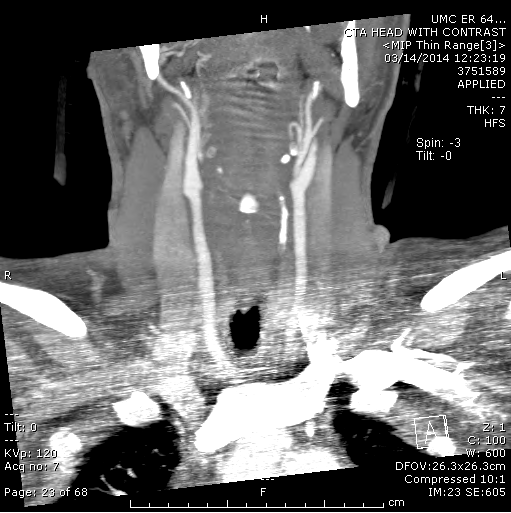
Well…..crap, this is dysarthria R sided hemiplegia. Stroke paged, obtained stat CTA head and neck, and then straight to Room 9 to intubate him. See the CTA imaging below:

CTA

Carotid artery dissection…

He obviously is not a tPA candidate, but he did go for an intervention procedure with the stroke service.  He did have a clot retrieved, but I have visited him on the floor a few days later and he had no improvement.

He went on to develop cerebral edema as well and had a large hemicraniectomy. He also had an ex-lap for an increase in abdominal distension, and found to have pancreatic ascites (3L removed from the abdomen). The spleen did fine.

Looking back, his mechanism did not support a reason for him to dissect a carotid. He had no external signs of injury, he had no neck pain, my guess is he did have a whiplash type injury but again, not something I expected. In addition, this man had a normal neuro exam upon presentation, full strength, no numbness/tingling with the exception of reporting headache, which I thought was from him striking his head.

After a lit review, there are a few teaching points I want to highlight from this case.

Traumatic Dissection (carotid, vertebral, spinal arteries)

– consider it with hangings, significant head/neck trauma, hyper-extension injuries, lateral rotation injuries of the head, base of the skull fx, c-spine fractures(especially those with displacement or involvement of the transverse foramen,vertebral body), lefort fractures (types II and III), or seat-belt sign over the neck
– Sign/Symptoms vary greatly. Stroke like symptoms are concerning but can be as generalized as headache/migraine, neck pain, neck hematoma, blindness, aphasia, weakness/sensory loss, Horner’s syndrome, tinnitus, CN deficits, diplopia, locked in syndrome, ataxia, vertigo, dizziness

Utility of a CXR

Hey Guys,
Thought I’d post this as I feel it was a mistake on my part, though fortunately no harm came from it.

50 year old guy this past Saturday (which was a ridiculous shift full of drunks and unhelmeted mopeds and motorcyclists with some very sick people) who was an unhelmeted moped rider going reportedly 60mph and wrecked while drinking alcohol and somehow managed not to make their way to Rm 9.
BP: 125/73. HR: 86. RR: 18. O2 saturation: 91% on room air. Temp: 97.6 F (oral)
A&Ox3, c/o shortness of breath and diffuse chest tenderness. Not really any obvious bad looking signs of trauma and had been log-rolled prior to my eval (triaged about 1hr 45min before I saw him).

I saw him, in no respiratory distress, maybe some expiratory wheezing on my exam, but with breath sounds on both sides and no crepitus that I could feel to his anterior chest. I finish my eval and just order a MAN scan based on his Hx and due to his drinking alcohol (EtOh 292)
Patient is taken to CT at 23:05 (about 2 hrs after I ordered them) and the nurse grabs me after the scan and tells me I need to look at his chest CT (only his C-spine images were up at the time which showed me all kinds of SubQ emphysema).

Chest CT Pneumo

Just a lesson learned; when it’s super busy like that shift was is when we need to be the most cautious and really think critically about the things we need to do, and not be in a hurry when we’re putting orders in.
The guy is doing well so far (and not intubated) and in THIS case no harm was done, I put a chest tube in without difficulty. But I really should have gotten a CXR to start.
His injuries included Bilateral 1st-6th Rib Fx’s, Pulmonary Contusions, Mediastinal Hematoma, Manubrium Fx, C7 Fx, T4, T7 Fx.

The Cunningham Technique

Young male with history of psychiatric illness and seizures presents with left arm pain after a fall. Patient thinks he slipped on ice, but is unsure. He reports no LOC, no head pain, no neck pain. Does not believe he had a seizure. No urinary incontinence, no tongue biting. Has severe pain in left shoulder. Physical exam shows small forehead abrasion, no c-spine tenderness, and decreased ROM to left shoulder.  He holds his arm internally rotated and adducted. There is an obvious deformity to the left shoulder with a defected palpated anterior.

3 view x rays ordered in triage read as negative for fracture or dislocation, but limited by poor patient positioning.

1

2

3

I was pretty sure that it was dislocated, so I went ahead and ordered the definitive axillary view.

As I was charting on another patient, the x-ray tech came over, looking slightly embarrassed, and said that she was pretty sure she had just reduced my patient’s shoulder as she was trying to get him in the proper position for the axillary view.  She said, “It was amazing, he couldn’t move it, then pop, and he has full ROM now.”

Nice.

Two minutes later, got a phone call from radiology…Might have missed a posterior dislocation…Looks great in the axillary view now…Would recommend getting repeat normal films to be sure that there was no fracture missed while it was not in proper position.

4

Ordered the repeat 3 view x-rays and went to make sure he was still reduced.  Found my patient still internally rotated, in pain, not able to move, and still with the hollow anteriorly.  Gently held his hand and arm and before he realized what I had done, pulled slightly and externally rotated and put it back in place.  As I called for the sling, he went to take his gown off and it slid back out as he extended his arm and moved it anteriorly.  Tried again to gently externally rotate it, but he was now on to me and and was tense and pulling against me.  Asked for suggestions other than sedation and got one from the one and only Dr. Martin Huecker: Try the Cunningham technique.

I went back in his room. He was looking a little wary.  I told him it’s not going to hurt; I was just going to massage his arm a little bit to see if it will go back in.  I held his left forearm in my left hand at the elbow and, using my right hand, massaged first his trapezius, then his deltoid, then his biceps, then his deltoid, then his trapezius, then his deltoid ….annnnnnnnnnnnd….. it slid back in place.  Patient looked as surprised as I did.  Immediately put him in a sling and swathe.  Got repeat x-rays in the sling.

5

6

7

He was in the department for about 30 minutes after that while awaiting x-ray reads and his arm stayed reduced while in the splint.  No fractures on x-ray.  He was discharged with orthopedic follow up in the sling.

One can find is a formal description of The Cunningham technique from the blog “Life in the Fast Lane.” http://lifeinthefastlane.com/cunninghams-shoulder-relocation/

  • Inform the patient of the procedure and the fact that it will be painless. It is important to relax the patient and confident reassurance is the first step towards this.
  • Sit the patient up with the back vertical. This can be done on a bed, chair or trolley, but preferably seated on a non-wheeled chair without arm rests.
  • Carefully support the arm while it is moved into the correct position, allowing the patient to help with the other arm. The correct position is with the arm adducted (next to the body) and pointing vertically down, the elbow is flexed at 90 degrees so that the forearm points horizontally and anteriorly.
  • The operator then squats/kneels to the side of the patient and facing the opposite direction to the patient. The operator then slips the hand between the patients forearm and body so that the patient’s wrist/hand is resting on the operator’s upper arm. Do not make pulling movements at any time as this will elicit pain and result in spasm.
  • Apply steady, very gentle traction (the weight of the operators forearm is quite enough) directly downwards once the patient is settled and pain free. Keep this gentle weight on the arm throughout, stop if any spasm or pain. Usually resting with the patients arm in this position will start to reduce the pain of spasm.
  • With the other hand, the operator then massages the trapezius, deltoid and biceps muscle sequentially, repeating this process and concentrating on the biceps brachii until the muscles are fully relaxed. A strong kneading of the biceps with the thumb anterior and the four fingers of the operator posterior to the arm is recommended. At this point the humeral head will relocate usually without any clear indication that the shoulder has reduced (no sound or ‘clunk’ feeling). This means that the shoulder must be observed/checked regularly to confirm when relocation has occurred (with shoulder exposed movement can be seen as the ‘step’ disappears.)

And a link to the blog with the description. It has a nice video.

The Wonder of Ultrasound

Great case I had in December. Overall good month, but this case was especially interesting, and humbling. It combines the excitement of chest pain, the enigma that is leg weakness, and humbling realization of a life threatening diagnosis.

Working in the ED one day and the psychiatry intern goes to see a patient. Routine patient, who had presented with right leg tingling and weakness that made it all the way to the back of the ED. Bed 15. Basic labs pre-ordered as well as a chest X-ray for a brief episode of chest pain that the patient told triage. Of course, the sixth vital sign, an ekg. Intern is with the patient for about 5 minutes and returns. He tells me that he is concerned that the patient is sick and wants me to see the patient sooner than later. He is concerned for possible stroke due to right leg weakness and pain. I tell him of course and I go see the patient.

HPI: 58 y/o AAM with hx of seizures on Dilantin but no other medications or PMH presents with chief complaint of right lower leg pain and tingling. Patient states that while at work today, he was lifting boxes and felt a sharp chest pain that started in the middle of his chest and radiated to between his shoulder blades. It then shot to his pelvis and went away. He went back to work for about 10 minutes then started to have right leg pain. He tried to drive to the hospital, but had to stop and call an ambulance due to sever RLE pain. All other symptoms had resolved at this point. No n/v, diaphoresis, dizziness, loss of bowel or bladder.

Pertinent Hx: NKDA, 30yr pack hx of smoking, dilantin.

Vitals: BP: 148/62, HR 66, RR 18, O2 100% T 98.5

Significant Physical Exam –

RRR, no m/r/g, CTAB, abd soft, nt, nd, no bruit, no pulsating mass

RLE strength 4/5, LLE 5/5.

No DP, PT, popliteal, or femoral pulse in the right leg.

At this point I was concerned. I excused myself and got the bedside ultrasound. In my head I wondered was this just a arterial occlusion, or was this something greater?

4 3 2 1

Well this is when I started to sweat. I tell the patient what I think my diagnosis is, and head back to my desk to get orders going. At this time I review the labs and chest X-ray.

CBC – WNL, CMP – K 3.3, UA WNL, Troponin Neg, Tox Screen Neg, Coags neg.

Chest Xray –

5

Any more concern? At this point I ordered a CTA of the Chest/Abdomen/Pelvis as well as called the surgery team. I wanted to get them involved early in the case that the patient deteriorates. I assessed the patients blood pressure at at the time was 130/60 and HR 58. I got the nurse to get the patient to the CT scanner as well as discussed with the trauma team. At this time patient had stable vital signs and pain controlled with morphine. Trauma evaluated and the CT resulted.

10 9 8 7 6

We now have our diagnosis. When patient got back from CT scanner, his blood pressure was increasing and now 150/80 and HR 68 with increasing pain.

Esmolol gtt was started, arterial line place, and the patient was transferred to another local hospital to undergo cardio-thoracic surgery for repair.

Diagnosis – Aortic Dissection from the level of the aortic valve down through the bifurcation of the iliac arteries. From the one slice, you can see he had no flow to the right leg. CTA demonstrated some collateral from the gastrics, but overall no flow.

Patient outcome – survived surgery. Otherwise have not been able to follow-up past that time. I shared this case because I feel it is a good representation of a case where easy bedside diagnostics can give you the diagnosis early and lead to your diagnosis. With the chest X-ray as well as the bedside ultrasound, we knew what the patient had. The CTA was just icing on the cake. Never be afraid to use the ultrasound. If it had been negative, this could have gone a completely different direction. Credit to the psychiatry resident for getting me involved early.

Use the ultrasound. Use it early. Diagnose early.

Aorta ultrasound.x